For those operating in the ever-shifting real estate environment in Colorado in 2025, an attractive opportunity has clearly developed: the Colorado multifamily investment in the niche 2-bedroom market. Although market change may be getting the attention in headlines, smart money is fixing intently on an area that is remarkably stable in comparison to other options. The state finds itself home to vibrant employment markets and an appealing lifestyle that continues to draw steady numbers of people into the area—all of whom have to live somewhere.
Colorado’s housing market is much like its mountain ranges: varied in terrain. We’ve experienced times of exponential growth, corrected by natural rebalancing. In 2025, it’s less about speculative gains but about finding the undervalued segments with intrinsic demand. It’s here that small-scale multifamily properties, in particular those offering two-bedroom units, stand out. They answer a core need that the boom in luxury development has largely sidestepped. This creates an important differentiator for savvy investors. This in-depth guide will break down why this particular segment represents the best Colorado multifamily investment opportunity right now and equip you with the knowledge to make savvy decisions and capitalize on current trends.

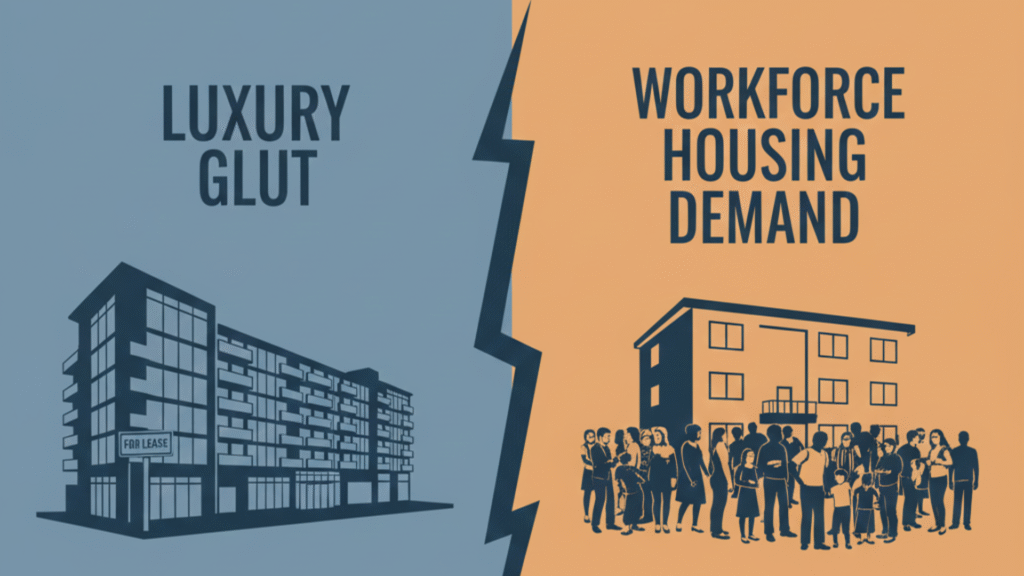
The Great Divide: Luxury Glut vs. Workforce Housing Demand
In order to fully appreciate the upside of a Colorado multifamily property in the 2-bedroom sweet spot, it is essential that we understand the current market dynamic—particularly for Colorado multifamily investment. Over the past ten years, developers in markets such as Denver and Colorado Springs have been concentrated on investing in many high-end, Class A apartment projects. These projects are filled with numerous amenity-driven small units: predominantly studio or one-bedroom units appealing to highly-paid, predominantly single individuals. Although these projects are very attractive, this market segment is experiencing unusually tough market conditions..
The Luxury Glut and Consequences: The end result of this influx of new luxury space has been a resulting oversupply of this type of space. Here we are seeing increasing levels of vacancy within these Class A structures, and with it, a requirement to be granted generous levels of concessions to secure and retain tenants, commonly in the realm of “two months free rent” or move-in incentives. In this arena, for the investor, pursuing declining rent levels and increasing levels of turnover within an oversupplied market of this type is a dangerous proposition rather than celebrating the ideal of a Colorado multifamily investment.
The Unmet Demand for Workforce Housing: At the opposite end, the roaring Colorado economy is also continuing to create jobs in many industries, ranging from healthcare, education, to tech and trade occupations. But the workers behind these jobs, in terms of teachers, nurses, policemen, young families, and young professionals, need more housing, in more substantial units, but also beyond the astronomical expense associated with new 2-bedroom, upscale apartments, while also lacking interest in the high-end competition found in the market for single-family homes.
Still, there is huge unmet demand for what is generically known as “workforce housing” or Class B and Class C apartments in multifamily projects. These are typically the existing, well-located, although often older, well-maintained apartments, designed for more practical layout schemes, in relatively moderate price ranges for these users. For such users, investment in a multifamily project in the state of Colorado seeks to satisfy a definite need, long felt by such groups.
Why “Two” is the Magic Number for Colorado Multifamily Investment
The demand for two-bedroom units is not random; it has a number of compelling socio-economic justifications that are specific to Colorado in the year of 2025. For this reason, the Colorado multi-family investment opportunity for this specific type of units is so compelling.
The Enduring Impact of Hybrid Work: Even with the rising requirement for a return to office, the hybrid model of work has become a reality in Colorado. A one-bedroom apartment is adequate for sleeping purposes but tends to get cramped when one or both of its inhabitants require a dedicated space for teleworking, online meetings, or focused work. With the requirement for space rising as a consequence of both homeowners’ or renters’ growing need for functionality despite the hybrid model of work, the demand for 2-bedroom units increases in favor of alternatives.
The Rise of the Roommate Economy: The desirable lifestyle and strong economy of Colorado mean higher costs of living. To deal with higher costs, especially for accommodations, more young professionals or graduates, or for that matter, friends, are living together. Having two bedrooms helps them share the costs in an effective manner, making a region that was unaffordable before feasible. The same two-bedroom place will just cost each of the two persons $950, which is a very reasonable price for only one of them to pay for that one-bedroom place costing $1,600.
This helps ensure an ever-consistent customer base for those properties that can be classified under this segment. It thus reinforces its status as an optimal place to invest money in Colorado multi-family properties.
Investment Security and Lower Turnover: In terms of the benefits that come with being a wise investor, 2-bedroom apartments display lower tenant turnover compared to studio apartments or one-bedroom apartments. Tenants who engage in home offices or roommates display a tendency to stay longer compared to the former. Staying longer means that the investor does not incur costs that come along with frequent turnovers. This is one part that makes up a successful Colorado multi-family real estate investment. Lease terms Map straight to operating costs.
Regional Deep Dive: Pinpointing Prime Areas for Colorado Multifamily Investment
Though the 2-bedroom “sweet spot” is an overall state-wide phenomenon, there are certain sub-markets within the state of Colorado where the conditions for such Colorado multi-family investment are exceptionally fertile. It is essential to be acutely aware of such regional subtleties for optimal profit realization.
1. Colorado Springs (East/Central Areas): The Springs’ strong defense sector, growing tech scene, and relatively affordable cost of living compared to Denver continue to attract locals. More importantly, the pipeline for new multifamily construction in Colorado Springs has slowed way down in 2025. This is a huge decrease compared to previous years.
The magical number in this case is finding them in their older, well-kept, petite multifamily buildings, such as duplexes, triplexes, or small apartment buildings with 4 to 12 units, in established neighborhoods, preferably in either the eastside or mid-town areas of Colorado Springs. These buildings are targeting exactly the workers and military personnel that want to rent out a two-bedroom unit, making it an attractive Colorado multifamily investment opportunity.
2. Aurora and Thornton (Denver Metro’s Eastern and Northern Suburbs): These “Secondary” markets within the Denver Metro Region today see strong absorption rates for properly priced multifamily product. Indeed, the City of Denver is largely overbuilt with luxury multifamily product. This means that the sheer number of individuals seeking relief for larger living space, value for their dollar, but still wanting to stay relatively close to the Metropolitan Area’s amenities, is seeking refuge in the Cities of Aurora and Thornton. Here, the existing 2-bedroom product is highly sought for offering just the right mix of price and accessibility to desired amenities, a particularly strong reason for a Colorado Multifamily Investment.
3. Grand Junction (The Western Slope’s Quiet Powerhouse): “While the Front Range seems to get all the attention,” the Western Slope’s Grand Junction is slowly but surely becoming a growing hub—especially in the healthcare and education markets. There’s also “a slower pace of life and cost of living that’s 25 percent less.”
Even though the need for housing is climbing and the addition of newer units can’t keep up, small-scale multi frame projects are “becoming extremely valuable in the Western Slope’s small markets.” People commuting to work as healthcare professionals, educators, and those working in the service industry are “looking for functional 2-bedroom units,” and it’s quickly becoming “a promising Colorado multifamily investment play not located in the mainstream cities” for Colorado multifamily investment.”.
The Recession-Proof Argument: A Secure Colorado Multifamily Investment
In current uncertain economic conditions, with rumors of possible slowdowns or inflation rates, the importance of investing in stability more than ever before cannot be overstated. A “recession-proof” argument makes the 2-bedroom small-scale multifamily market stand out from the rest of the real estate property types. Thus, this market makes the Colorado multifamily market for investment particularly Colorado multifamily investment even more attractive.
Defensive Investing in a Shifting Economy: When things turn tougher in the economy, residents tend to “rent down.” This involves leaving bigger and more costly single-family dwellings or high-end apartment buildings for more modestly priced rental options that still provide utility. The starting point in this rental downgrading is usually a 2-bedroom multifamily dwelling. Unlike high-end properties that experience a rise in vacancies during hard economic times, workforce housing properties continue to enjoy high demand due to a non-discretionary requirement for a place to reside.
Cap Rate Stability and Income Valuation: While single-family home prices can be volatile and are often influenced by emotional buying, small multifamily properties (especially 2-4 units) are primarily valued based on the income they generate (their Net Operating Income or NOI) and their Capitalization Rate (Cap Rate). In a softening sales market, a property generating consistent rental income can hold its value more effectively than a speculative single-family flip. Investors are buying cash flow and stability, not just appreciation, which is a hallmark of a sound Colorado multifamily investment.
Navigating the Market: How to Secure Your Colorado Multifamily Investment
Knowing the “why” is imperative, but knowing “how” is where implementation makes a huge difference in these areas. This is how you can differentiate yourself in a successful multifamily investment in Colorado in the 2-bedroom sweet spot.
1. Focus on “Vintage” Properties with Value-Add Potential: Find existing buildings that existed during the 1970s or 1980s or perhaps earlier but are in good condition and just in need of aesthetic renovations. This will make those buildings ideal for value-add real estate investing. But you have to keep in mind that not all renovations will positively affect the aesthetic value of the property sufficient enough to increase the potential rent of the property.
What I mean is simply that adding renovations like flooring, lighting, and paint, and enhancing the kitchen and bath space, can add an extraordinary value. To better explain this for you, simply consider the installation of high-quality and completely low-maintenance stone LVT flooring an incredible addition to your Colorado multi-family property investment and will drastically raise your returns as a landlord of multi-family properties in your capacity as a property investor in the state of Colorado.
2. Prioritize Location, Location, Location: Even in small-scale multifamily, location remains king. Target properties near employment centers, public transportation routes (like Denver’s RTD light rail, <a href=”https://www.rtd-denver.com/” target=”_blank” rel=”nofollow”> learn more here</a>) , reputable schools, and essential amenities (grocery stores, parks, community centers). Tenants seeking workforce housing are often reliant on convenient access to these necessities, making these locations highly desirable and ensuring consistent demand for your Colorado multifamily investment.
3. Optimize for Utility Efficiency: A quick way to increase your Net Operating Income (NOI) is through the effective management of costs. Look at properties that can be sub-metered where the tenants can take care of the utilities, and the property owner doesn’t have to. In addition, look at the possibility of incorporating energy-saving features such as energy-efficient windows, insulation, and even solar panels (referencing your previous blog post findings!). These will not only save your Colorado property investment costs but will also allow environmentally-conscious tenants to be drawn to your property.
4. Leverage Local Expertise: Learning from local real estate professionals in the real estate sector who are knowledgeable about multifamily properties is invaluable. They know what’s happening in the neighborhood they are representing, what the market rates are for rental properties, or if there are any potential off-market deals you might be qualified for—and can be the determinant of a good deal becoming a great one in the Colorado multifamily market.
5. Understand Financing Options: Small multifamily units (1-4 units) can usually be secured through typical residential financing, which is usually more favorable in terms of interest rates as opposed to commercial loans for larger apartment buildings. For properties that consist of 5+ units, commercial loans are used instead. It is necessary for you to familiarize yourself with these two types of loans, as well as find institutions that can assist you in acquiring investment properties based in Colorado.
The 2026 Outlook: Why Waiting Might Be Costly
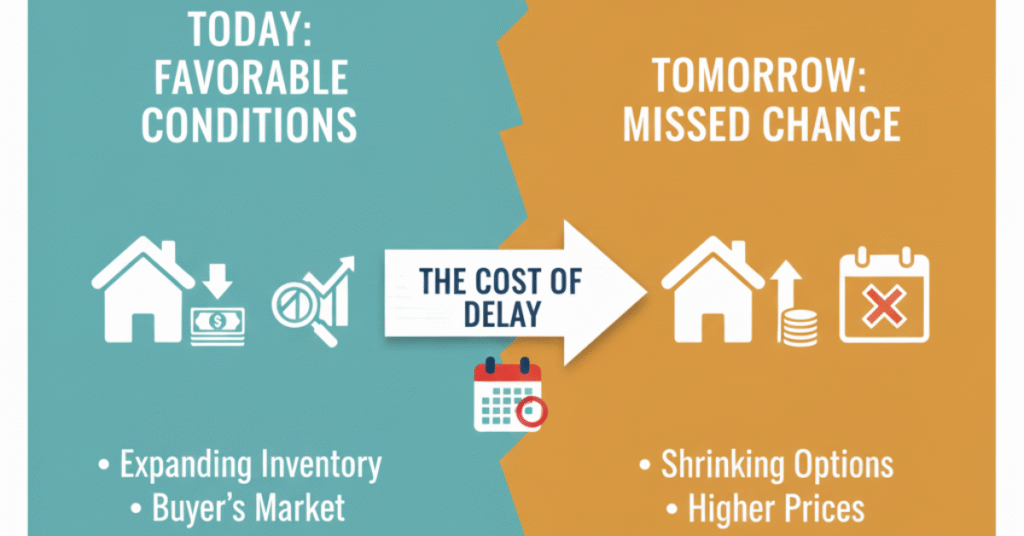
While 2025 presents a unique window of opportunity, some investors might be tempted to “wait and see” if interest rates drop further or if prices decline more significantly. However, a closer look at the market dynamics suggests that this passive approach could prove costly for a Colorado multifamily investment.
Colorado’s fundamental drivers – population growth, job creation, and a desirable lifestyle – remain incredibly strong. There is a significant amount of pent-up demand in the housing market. Many potential buyers, currently renters, are waiting for interest rates to ease further. The moment rates show a consistent downward trend, even a slight one (e.g., dipping below 6% or into the 5% range consistently), we could see a renewed surge in demand, impacting both the for-sale and rental markets.
When these “rate-locked” homeowners finally decide to sell and “move up,” or when first-time buyers flood the market, it will inevitably put upward pressure on prices across the board. The current stability in the small-scale multifamily sector could quickly transition back to a more competitive environment, eroding the advantageous entry points available now. Therefore, seizing the current opportunity for a Colorado multifamily investment in the 2-bedroom segment, where demand is currently high and supply is constrained, could be the most strategic move.
Conclusion: Your Smart Colorado Multifamily Investment for Stability and Growth
In a dynamic real estate environment like the present one, the key to profit is identifying and leveraging the paradigm shift. In the Colorado multifamily investment environment of 2025, the small-scale sweet spot for a 2-bedroom complex is a strategy with a strong winning formula. This particular niche meets a specific demand of the real estate environment: stability for investors.
So by recognizing the discrepancy in each piece in this puzzle for luxury versus workforce housing in Colorado, it’s possible for an investor to position themselves for success in Colorado multifamily investment. The requirements of the hybrid workforce, the roommate economy, and the defensible qualities of this class of real estate combine for an indication that this application within Colorado’s multifamily real estate market has an excellent future ahead of it. Stop being misled by market noise; look to the basics that remain constant. The multi-family 2-bed complex is more than an investment opportunity; it’s an opportunity to position yourself in an area of real estate that has been built for success in this ever-changing marketplace in Colorado.
FAQ Section
Q1: Why is the 2-bedroom sweet spot considered the best Colorado multifamily investment in 2025?
A: A sweet spot with 2 bedrooms is desirable because it addresses an important but underserved market demand for cost-effective, practical housing for workers, young singles, or those who share an apartment. Unlike the over-supplied luxury segment, such housing provides stability, steady demand because of the hybrid work model, as well as low tenant turnover rates, making them an attractive opportunity for investors because of the predictability of returns.
Q2: Which areas in Colorado are best for this type of multifamily investment?
A: Favorable areas would be East and Central Colorado Springs, Aurora, Thornton in the Denver metro, and actually expanding markets on the West Slope such as Grand Junction. These markets have robust tenant absorption rates and very little supply in the workforce housing market.
Q3: How does small-scale multifamily perform in a potentially softening market compared to single-family homes?
A: Small-scale multifamily often performs better in softening markets because its value is primarily driven by the income it generates (cash flow) rather than speculative appreciation. In economic downturns, people “rent down,” increasing demand for affordable units and making this a more recession-resilient Colorado multifamily investment.
Q4: What are some key strategies to enhance the profitability of a 2-bedroom multifamily investment?
A: Key tactics may involve buying “vintage” properties that offer potential for added value, such as through renovation, optimizing for maximum efficiency, possibly through sub-metering or energy improvements, or developing in areas proximate to employment hubs and necessary amenities. These are tactics that can optimize rents or reduce expenses.
Q5: Should I wait for interest rates to drop further before making a Colorado multifamily investment?
A: Even so, waiting may end up costing more in the long run. “Colorado has a strong market with underlying demand. When interest rates demonstrate a continuous path towards lowering, then a tremendous amount of pent-up demand for both buyers and renters can get released, resulting in competition for housing and potentially ushering in increased prices.”
“Grasping the current sweet spot in the 2-bedroom market is often suggested in relation to present entry points with regard to stability.”.